Newsletter
New Survey Sees AI Tools Taking Hold in IR
AI is having a clear impact on investor relations as corporate issuers tap AI for stress-testing messaging and benchmarking shareholder proposals, while taking a gradual approach before handing over IR to HAL.
This is according to a new survey by Gladstone Place Partners that canvassed IR practitioners, advisors, and other industry leaders to better understand how AI is changing the investor relations function.
Nearly 40% of those surveyed see a “dramatic change” from bringing AI tools into the IR profession, while about half said AI made some aspects “easier” but otherwise had little impact.
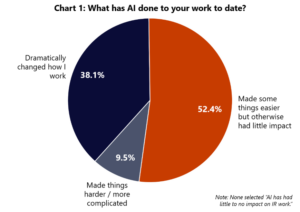 The reality – most IR professionals see evolution rather than revolution, primarily leveraging AI to research, challenge, and refine assumptions, with applications also emerging across proxy voting and governance work.
Here are the results of the survey and five themes for IR practitioners to consider:
Most IR practitioners agree that AI is a useful support tool. They see meaningful potential to support both institutional and retail investor targeting and engagement.
The promise of AI in IR will continue to grow as retail participation increases and pass-through voting gives individual investors a greater voice.
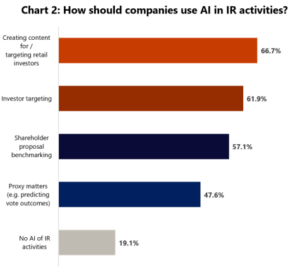 AI can also help investors and issuers review shareholder proposals and voting outcomes, compare governance practices, and prepare for important interactions.
Nearly 60% of respondents identified shareholder proposal benchmarking as an important AI use case.
For IR teams, time already comes at a premium. Most operate with lean resources, while earnings preparation alone can consume dozens of hours quarterly, before roadshows, conferences, and ongoing investor engagement are factored in.
Used well, AI can take on the labor-intensive work behind the scenes, giving IR teams more capacity to apply judgement, counsel management, and build relationships with investors.
One respondent noted that AI can support competitive and peer analysis, trends, and the “grunt work,” making it especially valuable for smaller teams. Another said the time saved could be used “more efficiently for objective analysis and building relationships.”
That efficiency, however, should augment (not replace) the human work at the core of IR. As one respondent put it, “human input and thinking cannot be replicated by a machine with biases.”
Two-thirds of practitioners surveyed said AI was useful for stress-testing company messaging (but, notably, not for initial drafting), while three-quarters supported using AI to simulate investor or analyst questions and reactions.
IROs seem to agree that AI is a helpful tool in pressure-testing assumptions: Does the story hold up? Where are there gaps? Some practitioners are using synthetic AI personas to mimic how specific analysts might react and what questions they may ask.
As one respondent shared, company materials should still be created through established processes, but “AI can bring different points of view and help pressure-test messaging and potential areas of criticism.” Similarly, Matthew Herman, Partner and General Counsel of Goldfinch Partners, said AI can be used to “check the work product, not generate it” because it’s critical there is always a human “sitting in between the AI tool and the audience.”
Adoption of AI tools within investor relations, where teams routinely handle sensitive information, requires a robust and thoughtful approach to governance. Leadership teams and Boards should understand how the business is embracing AI, with clear processes for verifying outputs and sources, and ensure human approval before materials reach the market.
Responsible adoption is also an organizational challenge. One respondent noted that it “will be interesting to see how companies – many of which are slow to adopt new practices – can get Boards and management comfortable with new ways of working.”
In an increasingly fragmented governance and stewardship landscape, new AI-powered tools are emerging to help sift through information and make voting decisions. AI is playing a role in investor meetings, as stewardship teams use AI to analyze company materials, compare disclosures over time and across peers, spot inconsistencies, and inform their questions for companies, especially around earnings and compensation.
Analysts and other stakeholders are also leaning more heavily on AI tools to find and interpret company information. That means that IROs and their teams need to think not only about how AI fits into their own workflows, but also how the LLMs are surfacing company information.
Companies should be tracking how they show up across the various LLMs and ensure that the information they publish is accessible for both traditional and AI-powered search and discovery. Our survey suggests practitioners are already moving in this direction, with strong support for publishing key content as webpages rather than PDFs and expanding public FAQs.
CONCLUSION
A clearer picture is emerging of AI’s role in investor relations: not a substitute for human judgment, but a tool to help IR teams process more information, challenge assumptions, and prepare more rigorously. The companies that use AI best will pair it with clear guardrails and human ownership, while preserving the judgment, credibility, and relationships that remain at the core of effective investors relations.
For more information on Gladstone Place Partners, visit our website. We also encourage you to read our weekly newsletter to stay up to date on corporate governance and activism news and insights.